Argus is an AI researcher. It reads the literature, runs its own experiments and hands you the whole session. Every claim is checked by code it cannot edit.
Real session: Argus found a ternary code with 31 codewords where Brouwer’s table lists 27, checked three ways. Read every step
Private research for companies and labs is scoped and quoted. Talk to us →
- Read12 papers read, 11 in full, out of 1,051 found
- Predict10 hypotheses registered, each with its disproof test and timestamp
- CheckH1, H2: no code above 243 or 162. Kept on the record as inconclusive
- BugStale graphs found in 5 sweep rows. Rows relabelled, scripts patched
- RunExact search under the 15-cycle: 9,341 orbits, two independent solvers
- VerifyLocked verifier: PASS. 31 words, distance 10, beats the table’s 27
- AuditAudit agent: the hit was filed under H9; a new H10 was registered for it, after the hit
- ReviewReviewer: where does the table’s 27 come from? Answered, paper corrected
- DonePaper after 9 referee rounds · 10h 39m · the whole session delivered
Every demo on this page comes from one real Argus session.
- papers read, 11 in full
- 12
- hypotheses, each with its disproof test, on the record
- 10
- one run, start to finish
- 10h 39m
- reviewer questions answered
- 7
- independent checks on the result
- 3
A result you can’t check is worth nothing.
AI can write polished research in hours. Fake citations and claims no one can check look exactly like good work. Today, the only way to check is to redo it.
- 1 in 6
sampled ICLR 2026 submissions had a fabricated citation, most missed by their peer reviewers.
GPTZero, December 2025 - 1 year
ban from arXiv's computer-science section for authors who post unchecked AI output.
arXiv policy, reported by The Scientist - 100M+
hours a year spent by peer reviewers checking other people's papers.
Aczel et al., 2021 - 887
papers from India retracted in 2025, second only to China. National rankings now penalise retractions.
Retraction Watch data, via ThePrint
A researcher that shows its work.
Most AI tools hand you an answer and ask for trust. Argus hands you the answer and everything behind it, in the order it happened. The demos below are taken from one real session.
The bounds are based on codes whose automorphisms are prescribed by transitive permutation groups. An exhaustive computer search was carried out to find the new codes.
The new bounds come from codes with automorphisms prescribed by transitive permutation groups.
Quote and its exact place in the paper saved with it. Later used to find the gap: P18 only tried transitive groups.Grounded in the literature
Argus reads the key papers in full, not just their abstracts. Every finding is pinned to the passage or result it came from.
A3(13,7) > 162, using unions of cosets of a small linear code.
A clique of ≥ 19 cosets of a 9-word code (≥ 171 words), or an equivalent, exists.
All sampled subgroups cap at 162.
Inconclusive. No code above 162 found; the search is not exhaustive. Kept on the record.
Predictions on the record
Each hypothesis is registered with the result that would disprove it, and timestamped, so you can see what was predicted, and when.
Where does the table’s 27 for A3(15,10) come from? Your paper says its origin is unknown, but the source you hold says Bitan and Etzion improved it to 27.
Checked the source text. I tried to obtain Bitan–Etzion; no full text or abstract was retrievable, so I could not test their 27-word code.
The paper now attributes 27 to Bitan and Etzion 1995, improving Svanström’s 24. The “origin unknown” sentence was replaced.
Answers to reviewers
Reviewers (today, our team and AI reviewer agents) can question any step. Argus investigates, answers and records what changed before the session can close.
Argus cannot overrule its checkers.
A claim passes only when checks outside the model’s control agree. Asking a model to be careful doesn’t make it careful.
- 01
Locked checkers
Fixed code recomputes anything decidable, such as the size of a code or a reported estimate. Argus cannot edit it.
- 02
Source comparison
For a record or a published figure, Argus fetches the source itself and compares. A mismatch fails outright.
- 03
Number trace
Every number in the answer must appear in a cited source or in Argus's own results.
- 04
Audit agent
A separate agent compares each verdict with the evidence and the registered prediction. Argus has to answer it.
$ python code/s0164_validate_15_10.py
standalone: size 31 mind 10 pairs 465 {10: 360, 13: 15, 11: 90} …
…
orbits by size {1: 3, 3: 8, 5: 6, 15: 9324} V= 9341
cliquer -m 31 rc 0 t 0.4 out 'size=3, weight=31: 1 4022 6413'
cliquer -m 32 rc 0 t 0.4 out ''
- Locked verifier31 words, distance 10, beats the live table’s 27Passed
- Independent scriptall 465 pairs compared, minimum distance 10Passed
- Codeword file31 words anyone can check, in the libraryPublic
- Audit agentcompared the verdict with the evidenceAgreed
- Audit flagfiled under H9; re-filed under a new H10, registered after the hitCorrected
The audit caught a misfiled result. The correction is part of the record.
Question in. Checked session out.
Argus works on its own for hours or days. Each step is recorded as it happens and stays in what you receive.
- 01
Ask
Send a question and say what a wrong answer would look like. We confirm code can check it before anything runs.
The brief- Beat entries of Brouwer’s table of A3(n,d), n ≤ 16
- Success: a code that beats one cell, checked with verify_claim and its codewords saved
- Checkable by code
- 02
Read
Argus reads the key papers in full and pins every finding to the passage it came from.
Reading list- 12 papers read, 11 in full
- Out of 1,051 found in search
- 48 findings pinned to a quoted passage
- 03
Predict, then test
Each hypothesis is registered with the result that would disprove it, and timestamped, so you can see what was predicted, and when.
Registered hypotheses- H1 · A3(14,7) > 243 · refuted if no clique ≥ 244
- H2 · A3(13,7) > 162 · refuted if all subgroups cap at 162
- Registered at steps 22–23. Testing began at step 42. H10 came after its result
- 04
Verify
Argus runs its own experiments in a sandbox. Checks it cannot edit decide what passes.
Checker verdicts- H10 · supported · locked verifier PASS
- H1, H2, H6, H8, H9 · inconclusive, kept on the record
- H3, H4, H5, H7 · set aside, with the reason recorded
- 05
Challenge
Reviewers (today, our team and AI reviewer agents) question any step. Argus answers before the session can close.
Reviewer thread- Q · Where does the table’s 27 come from?
- A · Bitan and Etzion, 1995, per the source Argus held
- Change · the paper’s “origin unknown” sentence replaced
- 06
Deliver
You get the answer and the full session, each claim linked to what produced it.
The session- A3(15,10) ≥ 31, where the table lists 27
- 12 papers, 10 hypotheses, 7 reviewer questions, 9 referee rounds
- Every claim linked to what produced it
The whole session, not a summary.
Every answer arrives with its full record: papers, hypotheses, code runs, checks and reviews, each claim linked to what produced it. Public sessions are published unedited.
See a real session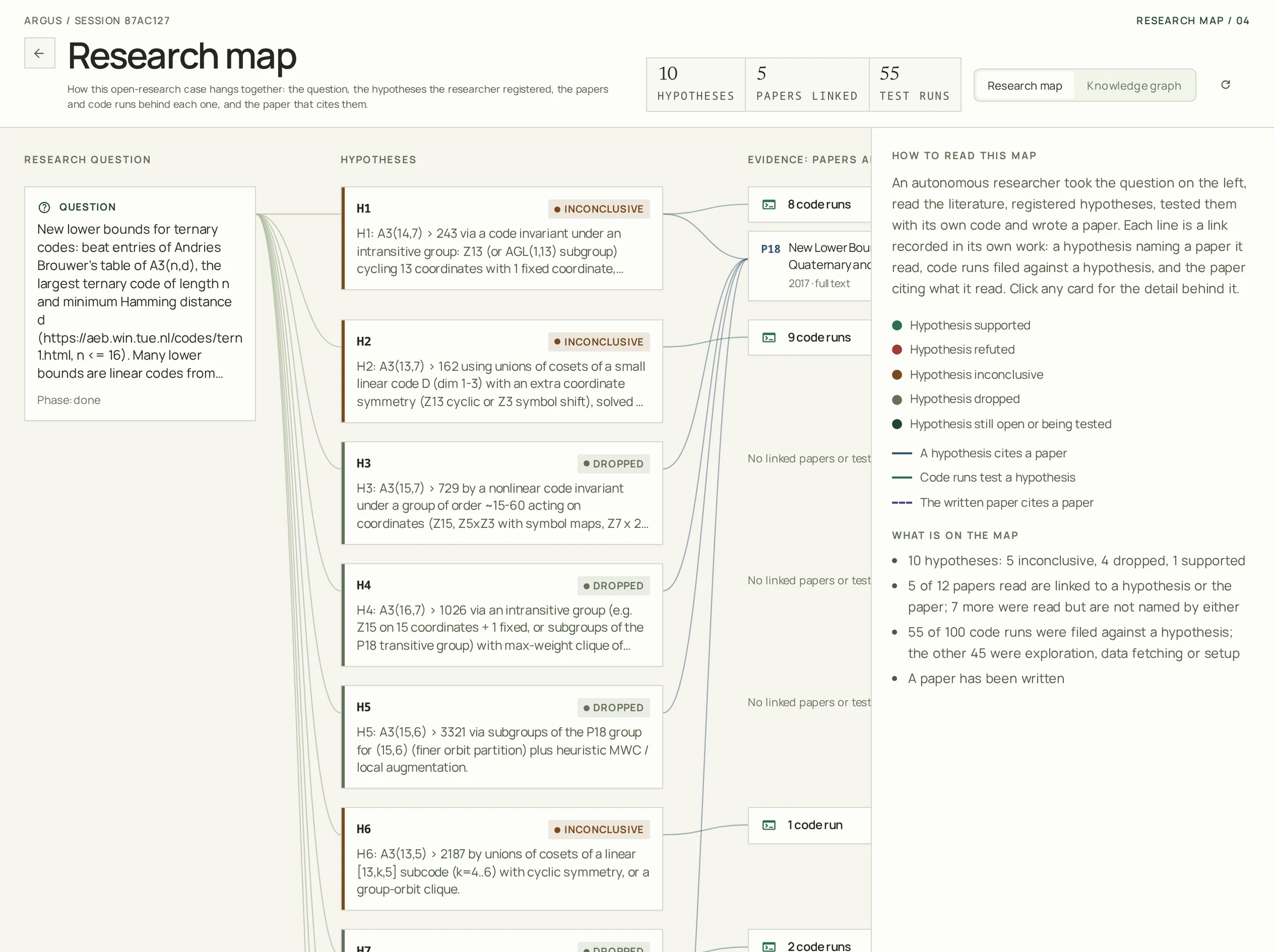
The research map of the same real session, as published. Open it to read every step.
- Hypotheseseach with its disproof test
- Code runsevery script and output
- Checksevery verdict, recorded
- Reviewsquestions, answers, changes
- Papernumbers traced to sources
For teams that build on other people’s results.
Today, trusting a result means weeks of redoing it. Argus hands you the work, already opened up.
Research groups
Maths, computer-science and theory groups improving best-known results, where code can check the answer.
R&D teams
Teams that must verify a published result, or reproduce it from public data, before they build on it.
Journals and funders
Editors and research offices that need to audit AI-produced research before accepting it.
Private when it needs to be. Auditable always.
What happens to your question and your data, in plain terms. Read the privacy policy.
Sandboxed execution
Code Argus writes runs in an isolated sandbox: it sees only its own workspace, holds no API keys, and is stopped at a fixed time limit.
Disclosed processors
Sessions run on frontier model APIs. Our privacy policy says which kinds of providers process your data, and why.
Private stays private
Private sessions are delivered to you alone and are never published unless you choose to.
No training on your data
We don't use your questions or data to train any model.
Deletion on request
Ask and we delete your personal data, subject only to legal retention duties.
Hosted by Obvix Labs
Submissions are stored on infrastructure we operate. Some processing happens where a provider is based.
What Argus will never do.
- 1.1
Present a failed check as a result.
- 1.2
Hide a failed experiment.
- 1.3
Backdate a prediction.
- 1.4
Let the model grade its own work.
- 1.5
Edit a public session before publishing it.
Research for the public good is free.
Research that matters to everyone should be open to everyone. If your question serves the public, Argus runs it free and we publish the session in full.
Free
For researchers, students and anyone with a question that matters beyond their own desk.
- Questions with a checkable answer
- Chosen for public value
- The full session, published for everyone
By quote
For companies and labs with a confidential question. We scope it with you before anything runs.
- The same checks and the full session
- Delivered to you alone
- Scoped and quoted up front
Is it really free?
Yes, for public research. If your question serves the public and code can check the answer, Argus runs it at no cost and the whole session is published for everyone. Private research is by quote.
What happens after I send a question?
We read it and tell you whether code could catch a wrong answer. If it can and it serves the public, Argus runs it and we send you the whole session when it finishes.
How long does a session take?
Hours to days, depending on the question. Every step is recorded as it happens, and you get the whole session when it finishes.
Is my private question kept confidential?
Yes. Private research is delivered only to you and is never published unless you choose to. We don't use your questions or data to train models.
What if Argus finds nothing?
You still get a checked verdict and the whole session: what was tried, what failed and why. Knowing a route is closed, with the evidence, saves the next person from redoing it.
Which model does Argus use?
Argus runs on frontier language models, with a separate agent auditing its verdicts. The checks that decide what passes are fixed code, not a model.
Built by Obvix Labs.
An applied AI team of four in Bangalore. We build AI that stays honest, grounded and controllable.

Karan Prasad
Founder & CEO

Pinak Kundu
Co-Founder & UX Engineer

Arpan Kumar De
Full Stack Engineer

Shubh Lamba
Researcher
Bring Argus your hardest question.
Public research is free. Private research by quote.